


If you own a contracting business, you've probably heard that virtual assistants are the way to go. Maybe you're ready to pull the trigger, or maybe you just have a few questions before you do. Either way, you're in the right place.
I'm here to tell you everything I've learned from a lot of good experiences — and a few bad ones.
Most contractors and business owners who try VAs and quit aren't failing because VAs don't work. They're failing because they jumped in before they were ready. Before they knew what to hand off, how to communicate it, or what to reasonably expect.
Hiring a VA is a lot like hiring any other employee — the more prepared you are, the better your onboarding, the clearer your expectations, the better your outcome will be.
I've hired, trained, and worked with virtual assistants for over 15 years. I've learned what they're genuinely great at, where they fall short, and exactly how you can use them to get leverage and buy back your time for your highest-paying activities. CEO-level work, not admin work. That's what this guide covers.
Is It Time? Signs You Should Hire Your First VA
Most business owners I work with are doing way too much work they could be paying someone $5, $15, or $50 to do. You've got to know what YOUR time is worth — and then you're more likely to see the value a VA delivers back to your bottom line.
Dan Martell covers this brilliantly in his book Buy Back Your Time — and it's the single best starting point for any business owner considering a VA.
Start here: for one week, log everything you do. Every task, every minute in your inbox, every minute on the phone with the bank, everything you handled that someone else could have handled.
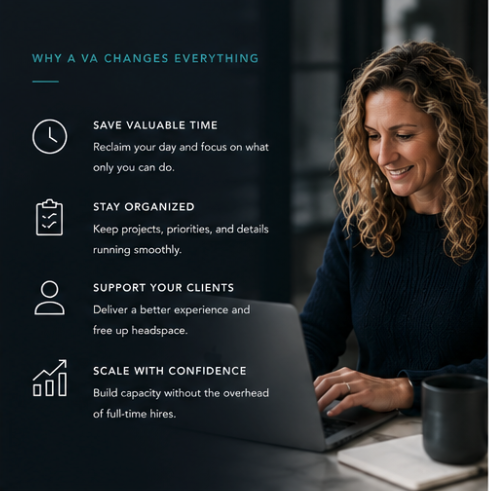
You'll be shocked — I was the first time. Most business owners who do this exercise are shocked by how much of their day is eaten up by things that have nothing to do with actually running or growing their business.
The signs you're ready are usually pretty clear. You're dropping balls on follow-ups. Estimates are taking 2-3 weeks to get out because you're the only one pulling them together. You're doing data entry, payroll, or desk work at 9, 10, or 11pm. Your inbox is a disaster. Vendors aren't getting called back. Your social media hasn't been touched in months — or you have no marketing at all. Who has time for that?!
The goal is to identify 20 hours per week of work you can hand off. That's the sweet spot. Below 20 hours, you'll struggle to keep a VA engaged and focused — they'll take on other clients, and your work will suffer for it. At 20 hours or more, you have someone who can genuinely learn your business, build real momentum, and become a true asset over time.
If you can find 20 hours of delegatable work — and most contractors can once they actually look — you're ready. If you have less and want to still move ahead, just know you're more likely to be lower on their priority list and they won't be as responsive or proactive in helping you.
What Can a VA Actually Do for Your Remodeling Business?
This is where I see a lot of people who've never hired a VA get confused or a little lost. They know they need help, but they can't picture what a VA would actually do all day. Here's what I've seen work best specifically for general contractors and remodelers.
Estimating support is the number one use case — and you already know that faster turnarounds on your estimates mean more conversions and more proposals accepted. The estimate is where you win or lose the job, and it's almost always the biggest bottleneck in a contracting business.
A skilled VA can gather all the information from your initial sales call or site visit — measurements, materials, scope notes — and get an estimate 80 to 90 percent of the way done before it ever hits your desk.
You review, you adjust, you send. What used to take you two weeks now takes two days. That matters enormously when your client is talking to three other contractors.
And here's the truth: estimating isn't something you outsource 100%. You can offload the bulk of it, but you ALWAYS need to be the final reviewer before it goes out. I've also seen VAs or remote hires who focus specifically on takeoffs. Sourcing the right VA for your type of estimating is how you want to structure your job ad and recruiting.
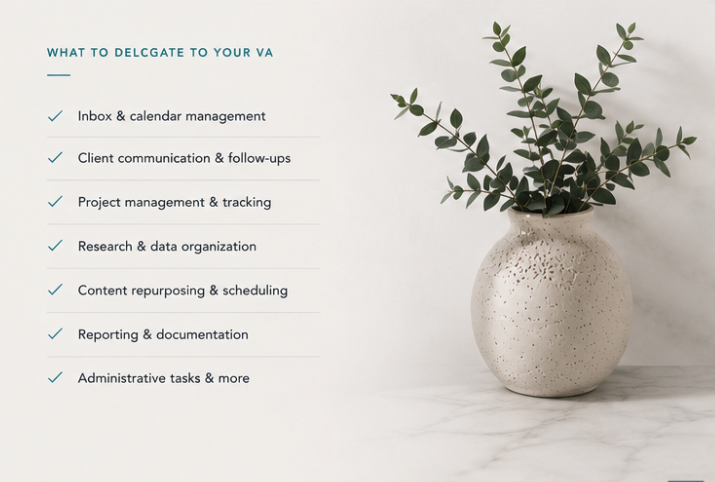
General back office and project management support (aka project coordination) is the second key area to offload to a remote team. Keeping your project management software clean and up to date, maintaining your cost catalog, preparing payroll, permits and insurance, updating pricing by calling vendors, communicating with subs and clients on your behalf, tracking job progress and daily logs, and flagging things that need your attention.
Social media and marketing content is another area where a VA can take meaningful work off your plate. They can handle video editing, caption writing, post scheduling, and keeping your business brand active and visible. The personal brand side is harder — nobody knows your voice better than you — but for your business brand, a VA can absolutely keep the lights on and the content flowing.
In the sales arena, I'm a big fan of having VAs monitor your CRM to make sure either you or your salespeople are staying on top of timely follow-ups. People underestimate the amount of sales lost simply by not following up on proposals sent — or not moving people to a job walk stage. This is so huge I could scream it.
Executive assistant work rounds out the list. Managing your calendar, handling your email inbox, scheduling calls, and making sure you're not buried in notifications and administrative noise. As a business owner, your job is to build the business — not be tied to your inbox.
One more that often gets overlooked: workflow setup and automation. If there are repetitive processes in your business that could be systematized — and there almost certainly are — a good VA can identify them, build the SOPs, and set up the automations. They're often faster at this than you would be, so be on the lookout for VAs who have created processes in former roles they've had.
VA vs. AI — When to Use Which
This question comes up a lot, and it's a good one. AI tools like ChatGPT and Claude are genuinely useful, and every good VA is already using them. But they're not the same thing, and they're not interchangeable. At the time of writing this, Claude CoWork and Dispatch were launched last month and those have been game changers for light task work — so who knows in the next six months. This guide will likely need an update!
When to use AI: AI is excellent when the task is well-defined, when you can give it clear inputs and get a useful output, or when you're looking for a starting point rather than a finished product. Drafting a first pass at something, generating ideas, summarizing information — AI handles that well.
Where AI falls short is nuance, real-world problem solving, and human contact. If you're a custom home remodeler, your estimates aren't cookie-cutter. I get it — most businesses are NOT routine and repetitive. Your projects have variables, your clients have specific preferences, your vendors have relationships.
The simplest way to think about it: AI is input-output. A VA is a human being who can think, adapt, and push back when something doesn't make sense. For anything that requires judgment, context, or ongoing relationship management, you want a person.
When to use a VA: A VA earns their place when the work requires human judgment, real-world context, or an ongoing relationship. If someone needs to call your vendor and negotiate a lead time, that's a VA. If a client has a concern that needs a thoughtful, personalized response, that's a VA. If you need someone to look at a scope of work, think through what's missing, and flag it before it becomes a problem — that's a VA.
The rule of thumb I use: if the task requires someone to think, not just process, lean toward a human. If it's something you can fully describe in a prompt and the output is predictable, AI might be your faster and cheaper move.
Where to Find the Right Virtual Assistant
Not all remote working platforms are created equal, and where you go to find your VA matters a lot depending on what you need done — the skills and tasks you're looking to hire for. Plus, if you just need something one-and-done or a temporary hire, there are people better suited for that type of work too.
Upwork is a broader freelance marketplace that covers everything from basic admin to highly specialized technical work. You'll find people inside the US and around the world. It's useful when you need a specific skill set and want the ability to compare candidates side by side.
The built-in time tracking and payment processing make it easy to manage — you don't need to sign up for a separate payment processor for overseas payments (like Wise or Remitly), and there's more protection from the platform than paying someone you don't know overseas for the first time.
Rates vary enormously — you can find quality people, but you have to sift through a lot of applicants. It's good for project-based work or when you need someone with a very specific technical skill. I prefer to post a job ad and wait for people to apply rather than searching through the sea of candidates.
Know that Upwork takes a cut of each payment, so candidates are receiving less per hour than you're paying. Some people like the convenience and the added layer of accountability. If someone does a poor job on Upwork, you can leave a negative review — so people are less likely to do low-quality work knowing their reputation is on the line. I find Upwork has some of the best candidates out there. It's my first choice.
Fiverr is best for one-off projects rather than ongoing VA relationships. Need a logo designed, a video edited, a one-time piece of content created, some online research, or data entry? Fiverr is fine for that. It's not where I'd go to find a long-term VA for your business — although I did hire someone for a one-off job and she ended up working for our company for nearly six years, so you can get lucky. The model is built around discrete deliverables, not ongoing working relationships. Same as Upwork — the platform takes a cut and reviews are visible so you're generally less likely to get burned.
HireMyMom.com is worth knowing about if you specifically want a US-based VA. As the name suggests, it connects businesses with US-based moms looking for flexible remote work. The quality is generally solid, the communication is easy, and the cultural alignment is seamless.
The tradeoff is cost — you're paying US market rates, which will be significantly higher than offshore options. For roles that require a lot of real-time communication, nuanced client interaction, or work that simply requires someone deeply familiar with the US market, it can be worth the premium. I've had limited luck with this platform, but I do include it when doing my search or posting a job, depending on the qualifications and skills I need.
OnlineJobs.ph is a popular go-to for Filipino VAs. It's a direct-hire platform — you post a job, candidates apply, you interview and hire directly. No agency markup. The talent pool is deep, the platform is straightforward, and if you know what you're looking for, you can find good people at very reasonable rates. Expect to pay somewhere between $5 and $12 an hour depending on experience level and skill set. This is where a lot of people start for administrative, estimating support, and back office roles.
Where in the World Should You Hire From?
I've hired VAs from the Philippines, Latin America, Europe, India, and the US over the years. Here's what I've found.
The Philippines is a very popular choice. Filipinos have a long history in the global outsourcing industry, they're deeply familiar with working for US-based businesses, their English proficiency is excellent, and their work ethic is genuinely impressive. They tend to be highly task-oriented, reliable, and loyal when you treat them well and give them enough hours to make the relationship worthwhile. One cultural note worth knowing: Filipino VAs tend to be deferential to authority. They won't always speak up if something is unclear or if they disagree with an approach. You have to build a relationship where they feel comfortable asking questions and flagging issues. Once you do, they open up and tell you what they think. Also, if you're wondering about the time difference — there are so many people in the Philippines who work on US time zones through remote jobs and call centers that it's super common. They've built their lifestyle around it.
Latin America is a strong option, particularly if time zone alignment is important to you. Most of Latin America overlaps significantly with US business hours, which makes real-time collaboration much easier than working with someone 12 or 13 hours ahead. LATAM VAs tend to be more proactive and more willing to take initiative, which can be a major asset depending on the role. Rates are generally a bit higher than the Philippines but still well below US market rates. I've even found a solid population of American expats — US-born, living overseas for lower costs. If you need someone who can jump on calls during your business day, think on their feet, and communicate in a more direct style, Latin America is worth serious consideration — especially helpful if you have a good number of Spanish-speaking subs you work with.
India has a large talent pool and strong technical capabilities, particularly for anything involving data, software, engineering, or analytical work. Communication styles can definitely vary, and the time zone difference from the US is significant. I've had good experiences with Indian VAs for specific technical tasks, especially lower-level tasks like data entry — things that can be done on a computer but don't require spoken English. Indian VAs can be harder to communicate with than Filipino VAs, and their accents don't make them as well suited for phone support if that's what you need.
I've had mixed results with India honestly — two of the best remote team members I've ever found were based there. But I've also found a lot who need heavy training, close oversight, and whose cultural norms make it harder to get them up to speed quickly. What has me look elsewhere first is that I'm generally best suited with someone proactive, who can think on their feet, stay a step ahead of me, work independently, and problem-solve. More often than not, the people I've connected with in India tend to be order-takers — they do what's asked but don't ask enough questions before acting, and their work quality can suffer as a result.
Eastern Europe has surprised me with some excellent talent, particularly for creative and technical roles like editing, social media, and web development. Strong education systems, good English, and a solid work ethic. Rates have been climbing as demand has increased. The Eastern Bloc countries can be a little harder to find at a lower price point, but there are some super-talented people with a strong cultural fit for the US work style.
US-based VAs offer the obvious advantages — no time zone issues, native English, full cultural alignment, and strong communication. For roles that require a lot of nuanced client interaction or specialized knowledge of the US market, they can be the right choice. The cost difference is real, though. You're paying US wages and taxes, which changes the math significantly compared to offshore options.
One region to approach with caution: I've had consistently poor results from VAs in certain African regions. Quality has been a persistent issue in my experience, and I've largely stopped looking there.
And one I'm genuinely excited about right now: I've been sourcing remote team members in Pakistan lately and they've become my current favorite as of this publishing. Worth keeping on your radar.
How to Hire the Right One
The biggest mistake people make when hiring a VA is treating the interview like the main filter. It's not. Anyone can sound great on a call, send you a polished portfolio, or submit an AI-generated resume. You need to test the actual work.
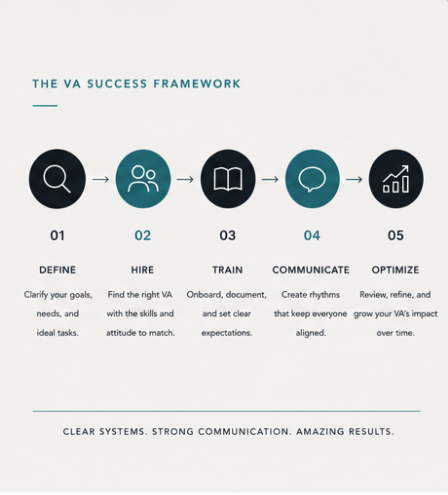
Before you post a job or reach out to candidates, get clear on exactly what you need. Don't post a generic "looking for a VA" listing. Define the role, define the tasks, define what success looks like. The more specific you are, the better your applicants will be.
When you have candidates you're interested in, give them a skills test before you make any decisions. If you need estimating support, give them a sample project with real information and ask them to build an estimate. If you need social media content, ask them to create a week's worth of posts for your business. If you need data work, give them a messy spreadsheet and ask them to clean it up — and have them tell you how long it took. You'll learn more from a skills test than from ten interviews.
One thing I've done a few times is give the exact same test to three different candidates and compare. I'm looking at how long it takes, the quality of the output, the questions they ask — or don't ask — the way they communicate throughout the process, and whether they follow up. It all signals something. Pay attention to what they're showing you between the lines. How they show up during the test is a strong indicator of how they'll show up when they're actually on your team.
In the interview itself, focus less on skills — you've already tested those — and more on personality, communication style, and how they think. Attitude and cultural fit are so important. Ask situational questions. How do they handle unclear instructions? What do they do when they don't understand what's being asked? Are they proactive, or purely task-driven? Do they ask good questions? I'm a huge fan of behavioral questions that sound like: "Tell me about a time when you..."
Red flags to watch for: vague answers about past work, responses that sound like they came straight from ChatGPT, candidates who immediately drop their rate the moment you push back (signals they were overinflating to start), and anyone who can't give you a concrete example of a time they solved a problem on their own.
Give yourself permission to not hire the first person you interview. Finding the right fit sometimes takes a few rounds. That's normal. The payoff of finding the right person is worth the patience.
My number one philosophy on teams: hire slowly, fire quickly.
Setting Your VA Up for Success
This is where most contractor-VA relationships succeed or fail, and it has nothing to do with the VA's skills. It has everything to do with how you onboard, train, and manage them.
From day one, be crystal clear about expectations. What does "done" mean for each task? What are your standards? What information do they need from you to do their job? Don't assume they'll figure it out. Write it down. Create SOPs — standard operating procedures — for every recurring task. A good VA will help you build these over time, but you need to start somewhere.
Communication is everything with a remote worker, especially one in a different time zone. Set up a regular check-in rhythm. Use a tool like Slack or WhatsApp so communication is organized and trackable. Be responsive when they have questions — a VA who's waiting on you for an answer isn't working, and that's slowing you both down.
Give them enough hours to actually know your business. The 20-hour minimum I mentioned earlier isn't just about keeping them engaged — it's about giving them the volume of work they need to get good at what you need them to do. VAs who work across five or six different clients at five hours each never develop deep expertise in any of them. Give them enough that your business becomes something they actually know.
Track their time and output, especially early on. This isn't about distrust — it's about visibility. If an estimate is taking three times longer than it should, you need to know that so you can course correct, not find out six weeks later when you're wondering why nothing is getting done.
And be patient. The first few weeks are an investment. They're learning your business, your standards, your preferences. The payoff comes after that ramp-up period, and when it does, it's significant.
What Does It Cost to Work with VAs?
The range is wide, and it depends on where you hire, what skills you need, and how many hours you're committing to.
For a Filipino VA hired directly through a platform like OnlineJobs.ph, expect to pay roughly $6 to $12 an hour for general admin and back office work, and $8 to $18 an hour for more specialized skills like estimating support, software management, or social media. A part-time VA at 20 hours a week works out to somewhere between $520 and $1,040 a month for general admin support, or $700 to $1,560 a month for more specialized skills.
Latin American VAs typically run higher — $10 to $22/hr depending on the role and the country — but you're generally getting stronger English skills and culture fit for that premium.
To put it in annual terms: a solid part-time offshore VA working 20 to 25 hours a week will cost you somewhere between $6,000 and $23,000 a year, depending on the rate and the hours. A full-time remote VA runs $10,000 to $38,000 depending on experience and location. Compare that to a full-time in-office employee with salary, benefits, payroll taxes, and overhead, and the math is pretty compelling.
The standard full-time work year is 2,080 hours (40 hours a week, 52 weeks). So the annual cost of a full-time remote VA looks like this:
- $5/hr — $10,400/year
- $8/hr — $16,640/year
- $10/hr — $20,800/year
- $12/hr — $24,960/year
- $15/hr — $31,200/year
Compare that to a US-based full-time employee at even $20/hr — that's $41,600 before you add payroll taxes, benefits, workers comp, and overhead. The real cost of a US employee is typically 1.25 to 1.4 times their base salary. So that $20/hr employee actually costs you closer to $52,000 to $58,000 a year.
For those of us in California, if you can find a solid employee under $35/hr, you're already looking at a base of $72,800 — and once you layer in state taxes, benefits, and compliance costs, that number climbs well past $90,000 to $100,000 all-in. The offshore math isn't even close.
One thing I always say: don't go as cheap as possible. A $3/hr VA with no experience and no specific skills will cost you far more in time and frustration than you'll save in wages. Pay a fair rate for someone with the right experience. Period.
Frequently Asked Questions
How Long Does It Take to Get a VA Up and Running?
Expect a real ramp-up period of four to six weeks. The first couple of weeks are mostly orientation and learning your processes. By weeks three and four, they should be hitting their stride on recurring tasks. By six weeks, a good VA should be running independently on the core parts of their role with minimal hand-holding.
Can I Trust a VA with Sensitive Business Information Like Estimates and Client Data?
This is a legitimate concern and one worth thinking through carefully. You can use time-tracking and screen-monitoring software if it's important to you. More practically, work with a VA who comes recommended or through a reputable platform with reviews and a track record. Use good judgment — give new VAs access to what they need to do the job, not to everything all at once. Build trust over time.
Do I Need to Provide Equipment?
Most offshore VAs provide their own equipment, and for direct hires, it's standard for them to supply their own computer and internet connection. A small internet stipend is sometimes offered and is appreciated but generally not expected. You will need to pay for any software subscriptions they use on your behalf — Google Drive, your CRM, project management tools, and so on.
What's the Difference Between Hiring Directly and Using an Agency?
Direct hiring gives you more control and usually a lower cost. You're doing your own recruiting, vetting, onboarding, and management. An agency handles recruiting and often provides HR support, payroll management, and a replacement guarantee if things don't work out. For a first-time VA hire, the support structure of an agency can be well worth the added cost.
How Do I Pay an Overseas VA?
If you're hiring through a platform like Upwork or Fiverr, payment is handled through the platform — straightforward and protected. For direct hires, the most common options are Wise (formerly TransferWise), PayPal, or direct bank transfer. Wise is generally the most cost-effective for recurring international payments with lower fees and better exchange rates than PayPal.
What If I Don't Have Any SOPs or Documented Processes Yet?
That's actually fine — and more common than you'd think. Start by having your VA shadow you, sit in on calls, or watch you work through a task via screen share. Then have them write up what they observed as a draft SOP. You review it, correct it, and now you have a starting document. It doesn't need to be perfect on day one.
What If My VA Starts Taking on Other Clients and My Work Suffers?
This is a real risk, especially if you're giving them fewer than 20 hours a week. The signs are usually pretty clear — slower response times, declining work quality, missed deadlines. Address it directly and early. If you're on a platform like Upwork, your time-tracking data will show you what's happening. If you're hiring direct, build in regular check-ins and output reviews.
Can a VA Help Me with Construction-Specific Software Like JobTread, Buildertrend, or CoConstruct?
Yes — and this is one of the most underutilized opportunities I see with contractors. A good VA can be trained on virtually any software platform. The learning curve is faster if they already have construction industry experience, but motivated VAs will dig into help documentation, watch training videos, and get certified on platforms they don't know yet.
I've Tried a VA Before and It Didn't Work. Should I Try Again?
Almost certainly yes — but with a different approach. The most common reasons VA relationships fail are: hiring without a clearly defined role, skipping the skills test, not investing in onboarding, or not giving them enough hours to build momentum. If any of those sound familiar, that's your answer. The concept works. The execution is where most people come up short the first time.
The Bottom Line
Virtual assistants are not a magic fix. They won't solve problems that come from a lack of systems, unclear communication, or an owner who isn't willing to let go of control. But for a contractor who is genuinely ready to delegate — who has done the time audit, knows what they need to hand off, and is willing to invest in onboarding properly — a great VA is genuinely one of the highest-leverage hires you can make.
The contractors I've seen get the most out of their VAs are the ones who treated the relationship seriously from the start. They were clear, they were consistent, they communicated well, and they gave their VA the hours and the information they needed to do the job. The result, in most cases, was a team member who became indispensable.
If you're ready to take the next step and want help figuring out where to start, reach out. This is exactly the kind of thing I help contractors work through.
Join the Mailing List
Get practical ideas for running your remodeling or custom building business with less chaos, straight from Polly.
Your name and email are used to send the list. Read the Privacy Policy.
Let’s Look at What’s Happening in Your Business.
Bring the question that keeps coming back. We’ll talk about what you want to change and whether working together makes sense.
Book a Discovery Call